

Contents
- 1. Introduction and Background
- 2. Spelling Distribution: Gelatine vs Gelatin
- 3. Basic Concepts: Differences in Forms
- 4. Conversion Guide for Gelatin and Gelatine
- 5. Why more people are using gelatin (Historical Evolution)
- 6. Impact of the Pharmaceutical Industry and Global Standardization
- 7. The Commonwealth and Niche Industry Resistance
- 8. Conclusion
- 9. Supplement: Gelatin vs. Hydrolyzed Collagen
Humans started using gelatin 8000 years ago, but "Gelatine / Gelatin" appeared around the 18th century.
“Gelatin” actually evolved from “Gelatine”, but it came from behind to take the lead, gradually pushing Gelatine to the margins. Both spellings refer to the exact same food ingredient—gelatin. It is a natural animal-sourced product derived from collagen. Their common ancestor traces back to the Latin gelare. After this pair of words was born, they experienced different historical evolutions on opposite sides of the Atlantic. Now, regions spelling it "gelatine" associate it more with leaf gelatin(View product details from gelatin sheet suppliers), while "Gelatin" is usually powder.
This article will answer these questions:
- The specific meanings of gelatin and gelatine, what differences exist in the forms they point to, and how to spell it correctly when both coexist?
Deep dive into these questions (reading this part takes about 20 minutes):
- Why are more and more people in most regions using "gelatin" (this isn't just a surface-level issue of "American English" beating "British English"), and how has the history of this ancient material influenced the evolution of language?
- In the meantime, we provide a conversion guide.
 Chart: gelatin came from behind to win; people in most regions started using gelatin. Red: Regions mainly using gelatin in 2026 Blue: Regions mainly using gelatine in 2026 Data source: Google Trends
Spelling gelatine or gelatin just depends on your field
| Field | Dominant Spelling | Driving Factors | Status of Gelatine |
|---|---|---|---|
| International Pharma (B2B) | 'Gelatin' | Pharmacopoeia Harmonization (USP/EP/JP E-55) | Rare, only seen in old corporate directories |
| Food Regulations (Global) | 'Gelatin' | Codex Alimentarius / FDA | Occasionally seen in old translated regulations |
| UK Retail Food | 'Gelatine' | Tradition, Brand Heritage (Waitrose, Dr. Oetker) | High (as a mark of premium/traditional products) |
| AUS/NZ Food Market | 'Gelatine' | Local protection, differentiation from imports | Medium (as a premium symbol for local products) |
| Explosives Industry | 'Gelatine' | Regulatory Inertia (UN/DOT standards) | High (Proper noun: Blasting Gelatine) |
| Art & Photography | 'Gelatin' | Museum Cataloging Standards (MoMA) | Low (only seen in 19th-century citations) |
| Academic Journals | 'Gelatin' | Submission guidelines, database indexing | Extremely Low (viewed as non-standard spelling) |
| Internet Search | 'Gelatin' | SEO algorithms, autocorrect | Extremely Low (long-tail keyword) |
Basic Concepts of Gelatine & Gelatin
What is Gelatine

In the UK, Europe, and regions influenced by their culinary traditions, "Gelatine" in recipes usually defaults to leaf/sheet form. Gelatine sheets, like gelatin powder, are pure protein gum extracted from animal bones and skin (mainly cows, pigs), but they are transparent thin sheets made through decolorization and drying. Leaf/Sheet Gelatine is favored by professional chefs and baking enthusiasts because the finished product is clearer and has a smoother mouthfeel.
What is Gelatin
You could also say gelatin powder is powdered gelatine. When referring to "Gelatin" (American context): In the US, the most common type found on supermarket shelves for home baking is small sachets of gelatin powder (like the famous Knox brand). Therefore, if an American recipe writes "Gelatin", it usually defaults to you using powder. When using it, you need to mix it with cold water to "bloom" it first, then dissolve it in warm liquid.
Differences between Gelatine and Gelatin
Gelatine:
- Easy to handle: Use single sheets, squeeze out water after soaking, then add to warm mixture.
- Better finish: Clearer after dissolving, no impurities, smooth texture, almost no off-flavor.
- High standardization: The setting power of each sheet is relatively stable, making conversion easy.

Gelatin:
- Easy to measure (use spoons), convenient storage, but sometimes might have a slight fishy/meaty smell, and if not dissolved thoroughly, it affects the clarity of the finished product.
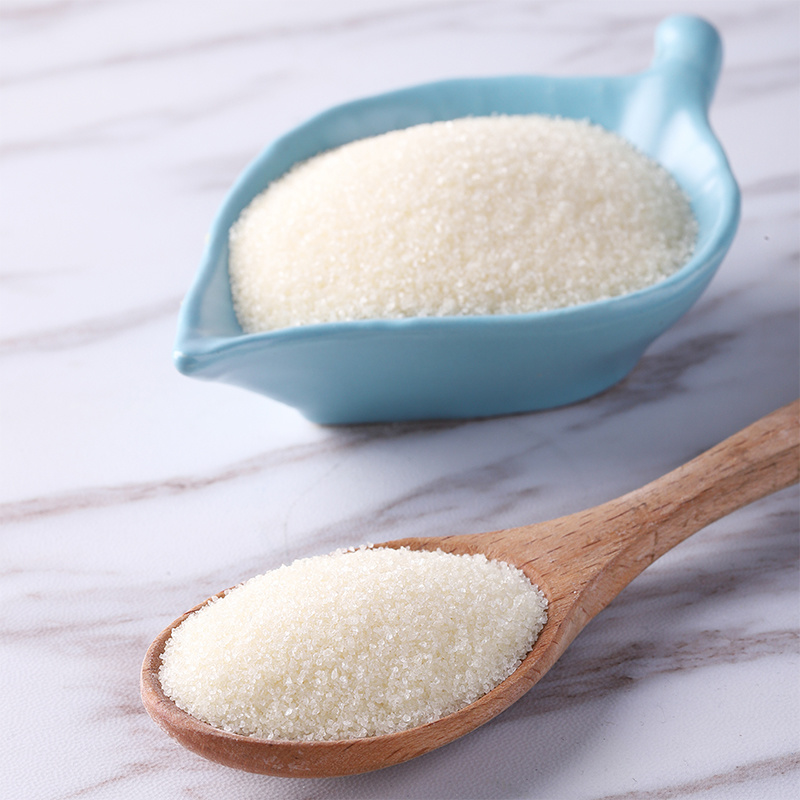
For home baking/beginners: Gelatin sheets are generally recommended because the process of "soaking and squeezing" is more intuitive, has a lower failure rate, and results in a more stable texture in the finished product.
Conversion Guide for Gelatin and Gelatine
| Recipe Requires | You Have | Conversion Rule (Rule of Thumb) |
|---|---|---|
| 1 sachet gelatin powder (~7g / 2.5 tsp) | Gelatine sheets | Use about 3 to 4 sheets of standard leaf gelatine |
| 4 gelatine sheets (standard size) | Gelatin powder | Use about 1 tablespoon (~7g) of gelatin powder |
Crucial Tip: Pay Attention to "Bloom Strength"
More important than distinguishing between "powder" or "sheet" is understanding its setting strength (Bloom value). Different brands and grades of gelatin (like Gold, Silver, Bronze) have different Bloom values, which directly affects the texture of the finished product. For mousses or mirror glazes requiring precise texture, it's best to follow the brand and type specified in the original recipe, or do a professional conversion based on Bloom value. For ordinary recipes, you can use the general ratio above.
Click here to learn more about our professional conversion guide
Why more people are using 'gelatin'
The linguistic trajectory of 'gelatin':
Indo-European root *gel- (cold or freeze) → Latin gelare (meaning "freeze" or "congeal") → Italian gelatina (diminutive of gelata - meaning "jelly") → French word gélatine → gelatine → gelatin
The spelling 'gelatina' still exists today. Click to learn about the meaning of 'gelatina' in a modern context.
Before ‘gélatine’ - gel-gelare: Early exploration of gelatin
'gel- gelare'
Before the 16th century AD: Gelatin was mainly used for food and glue. In this period, humans cooled bone broth to crack it into edible jelly; used for food (10th-century fish jelly recipes; 14th-century jelly broth) and adhesives (primitive glue for tools and clothes).
The etymology of gel- gelare reveals humanity's basic understanding of this substance: a material that mimics the physical state of ice (solidifies when cooled) but is distinct in its organic origin.
From ‘gelare’ to Gélatine: The start of gelatin industrialization
'gélatine'
Historically, mastering gelatin extraction techniques was a sign of exquisite culinary skill. The French were pioneers in applying gélatine, using tedious hot extraction of collagen from bones to create exquisite en gelée dishes that defined haute cuisine.

- Napoleonic Wars: Due to meat shortages, gelatin was systematically studied and widely consumed as a protein source.
- 1818: The first large-scale gelatin production company was born in Lyon, France.
- 1833: French pharmacist Moths obtained a patent for gelatin capsules, making medicine easier to take and masking bitterness.
Gélatine, rooted in the word-formation tradition of Romance languages, was fixed in usage in the 17th century.
The establishment of the ‘gelatine’ spelling
The word "gelatine" entered the English vocabulary around 1713, borrowed directly from the French word gélatine. Keeping the French suffix "-e" was standard borrowing practice; in French and Italian grammatical structures, the final vowel often is necessary for pronunciation and gender/number inflection. For British chemists and cooks at the time, the spelling Gelatine was not only faithful to the etymology but also fit the English habit of naming substances ending in "-ine" (like the later morphine, caffeine, glycerine).
This spelling spread to Australia, New Zealand, Canada, and South Africa with the expansion of the British Empire. In early literature, recipes, and trade manifests in these regions, Gelatine was the only orthodox spelling. It represented an Old World tradition, fitting its identity as a complex natural product extracted from animal bones and connective tissue.
From 'gelatine' to 'gelatin': Gelatin enters mass life, gelatin becomes the Western Hemisphere norm
The establishment of the 'gelatin' spelling
Gelatine remained dominant in British English and culinary contexts. The shortened form gelatin, appearing around 1800, became the standard form in American English and scientific literature.
In the early 19th century, Webster, the father of American dictionaries, dedicated himself to simplifying English spelling and declared America's linguistic independence from Britain. In his famous dictionary published in 1828, Webster applied the principle of "rational spelling". He believed silent letters were superfluous. Just as he changed colour to color and centre to center, he standardized gelatine to gelatin.
However, a more important driver for the establishment of the gelatin spelling came from the chemistry community in the 19th century. Around 1800, with the budding of organic chemistry, scientists began trying to systematically classify chemical naming suffixes.
- Alkaloids: Agreed to use the suffix -ine, e.g., Quinine, Cocaine.
- Neutral substances & Proteins: Agreed to use the suffix -in, e.g., Albumin, Pepsin, Protein.
Although Gelatin is not a single molecule but a mixture of polypeptides, its chemical properties are closer to neutral proteins than alkaline alkaloids. Therefore, in American scientific literature and subsequently published dictionaries, Gelatin without the "e" at the end was considered the "correct" spelling fitting scientific taxonomy. This spelling was quickly adopted by the American Chemical Society and subsequent scientific publications, and followed into the early US Pharmacopeia.
This tiny change was later consolidated in the 20th century by American publishers and industrial manufacturers, making "Gelatin" the norm in the Western Hemisphere.
- Late 19th century: US company Eli Lilly pushed for automated production of hard gelatin capsules.
- 1913: The Davis Company in Detroit, USA, invented the world's first machine for automatically producing hard gelatin capsules.
'Gelatin' truly becomes a household word:

This took the application of gelatin to a new level, making it omnipresent . Thus, gelatin became a basic and ubiquitous ingredient in many foods and was popularized globally.
Another event that made 'gelatin' even more common was:
In 1845, American Peter Cooper first invented a gelatinous dessert and obtained a patent. In 1897, fruit flavors were added to it, named "Jell-O". In 1904, the first book on making Jell-O was published. In the US, nearly 3 billion boxes of "Jell-O" are sold annually. The British Rowntree Company invented another gelatinous dessert: "Jelly cubes". Although this product sold well in the UK, it didn't open up overseas markets.
The birth of gummy candies
But in the early 20th century, the US introduced fruit gummies, which swept the nation in the 50s. In the 30s, the now world-famous gelatin treats pressed into animal shapes (like bears) were introduced.
In the American context, the industrialization of this process made the ingredient mass-market. "Jell-O" being ubiquitous as the proprietary synonym for gelatin desserts highlights this cultural shift. Once a labor-intensive extract reserved for the aristocracy, through industrial refining and aggressive marketing ("Watch it shimmy, watch it shake"), it became a staple in the American family pantry.

The Reprieve of 'Gelatine'
In the late 19th century, although the British scientific community began to realize the chaos of chemical naming, Gelatine remained steady as a rock in the general public and commercial sectors. At this time, an interesting "dual-track system" phenomenon appeared:
- Scientific context: Even in the UK, rigorous chemical journals started tending to use gelatin to distinguish its chemical attributes.
- Commercial context: Famous British gelatin manufacturers, like Davis Gelatine founded in the late 19th century (which later grew in New Zealand and Australia), still insisted on using Gelatine in their brand names. This spelling was closely linked to "cooking", "jelly", and "desserts" in the minds of consumers, carrying a sense of high-class French cuisine.
However, this balance was about to be broken by the wave of pharmaceutical industry standardization in the 20th century.
Impact of Pharmaceutical Globalization on 'Gelatin' Spelling
If etymology determined the divergence in spelling, then the globalization of the pharmaceutical industry was the key force deciding the fate of Gelatine.
As a core raw material for pharmaceutical capsules (soft and hard), tablet binders, and plasma substitutes, gelatin's purity, physical properties (like gel strength/Bloom), and microbial limits are subject to extremely strict regulation. In this highly regulated environment, unified naming is not just a convenience, but a legal requirement.
1. The Hegemony of Pharmacopoeias: The Language Defining Global Trade
In the highly regulated field of the pharmaceutical industry, unified naming is not just for communication convenience, but a mandatory legal requirement.
- USP's Long-term Insistence: Relying on the absolute dominance of the US market after WWII, the United States Pharmacopeia (USP) always insisted on using Gelatin. For global suppliers hoping to enter the US market, regardless of their native language, export packaging and Certificates of Analysis (COA) must be printed with "Gelatin USP".
- BP's Compromise and Evolution: The history of the British Pharmacopoeia (BP) records the decline of Gelatine. From mixed spelling in the late 19th century to deep integration with European standards in the 21st century, the BP finally "surrendered", setting Gelatin as the only official monograph title.
- The Fatal Blow from the Pharmacopoeial Discussion Group (PDG): Aiming to harmonize standards of USP, Ph. Eur. (European Pharmacopoeia), and JP (Japanese Pharmacopoeia), the PDG signed a harmonization document coded E-55. This document explicitly set the unified English title as GELATIN. This means in the locations of the world's three core pharmacopoeias, the officially recognized name has become one.
2. Market Education by Industrial Giants
If pharmacopoeias influenced the B2B sector, then the food industry and consumer brands completed the reshaping of cognition in the B2C market.
- Codex Alimentarius: Under the framework of FAO and WHO, the code for edible gelatin is 428, and the preferred English name is Gelatin. Large export-oriented enterprises in China (like E-KING Gelatin) adopted this spelling uniformly in English promotion to conform to the international mainstream.
- The Jell-O Effect: In 1897, the US brand Jell-O was registered and promoted pre-flavored "Granulated Gelatin" to the market. With the global export of American fast food culture and processed foods, Gelatin on packaging ingredient lists subtly educated global consumers, making Gelatine gradually seen as an old, European existence.
3. Normalization of Terminology: From Photography to Academia
- Photography Art: Early literature mostly used Photographic Gelatine. However, as photography entered the museum system (like MoMA, Getty), art historians unified the terms. The modern standard cataloging format is set as Gelatin Silver Print.
- Academic Databases: In PubMed and CAS (Chemical Abstracts Service), substance indexing is unique. The main index term for CAS No. 9000-70-8 is Gelatin. This academic infrastructure ensures that in serious scientific research, Gelatine can only exist as a historical synonym.
4. Algorithmic Ruling in the Digital Age
Internet infrastructure has accelerated spelling evolution.
- SEO and Keyword Hegemony: Google Trends shows the global search volume for Gelatin far exceeds Gelatine. Content creators must prioritize the former in metadata for click-through rates.
- Auto-correction Mechanism: Modern input methods and correction tools like Grammarly default to American or "International English" settings, often flagging Gelatine as a potential error. This technical guidance is reshaping the spelling habits of the younger generation.
The shift in spelling from Gelatine to Gelatin is essentially the result of global trade standardization, US market dominance, and digital indexing technology driving it together. This process not only eliminated linguistic redundancy but also marks the comprehensive replacement of traditional orthography by modern industrial logic.
The Resistance of the Commonwealth and Residue in Special Industries: The Cultural Defense Line of 'Gelatine'
Today, where Gelatin occupies a dominant position, the spelling with the suffix “e” has not died out but has retreated to specific markets and technical fields, evolving into a cultural symbol and legal legacy.
1. The Retail Defense Line of Commonwealth Markets: Nostalgia and Identity
In the UK, Australia, and New Zealand, Gelatine remains synonymous with local sentiment and high quality.
- The UK's "Tradition" Label:
- Private Label Strategy: Mainstream UK supermarkets like Waitrose and Tesco insist on using the old spelling on "Leaf Gelatine" or "Beef Gelatine Powder" in the baking aisle. This is seen as a tribute to traditional English cooking (like Trifle).
- Localization by Multinationals: The German brand Dr. Oetker shows high flexibility: using Gelatine on UK packaging to cater to local habits, while switching to Gelatin in other international markets.
- Culinary Education: Influenced by the French culinary system, traditional British culinary schools still view Gelatine as the standard, although the younger generation influenced by molecular gastronomy has started leaning towards the American spelling.
- Price Gaming in AUS/NZ:
- Status Symbol: Products marked "Australian Gelatine" on the market are usually priced much higher than imported "Gelatin". Here, the "e" has become a visual code for "locally produced" and "premium", while the version without "e" is seen as cheap bulk imports.
- Regulatory Balance: Food Standards Australia New Zealand (FSANZ) mixes both in daily documents, but must revert to Gelatin when citing USDA data to ensure compliance.
2. Frozen Industrial Terms: Explosives and Regulations
In certain special high-tech fields, spelling is "solidified" due to legal and safety risks.
- Nobel's Legacy: In 1875, the gelatinous explosive invented by Alfred Nobel was named Blasting Gelatine.
- Legal Validity and Safety Risks:
- Regulatory Solidification: Hazardous materials transport is strictly governed by UN numbers and Department of Transportation (e.g., US DOT) regulations. These provisions, established in the early 20th century, used Gelatine. Amending these lists involves huge administrative costs and safety identification risks, causing this spelling to remain immovable in modern technical manuals.
- Product Differentiation: The industry uses the "e" to strictly distinguish Blasting Gelatine (powerful nitroglycerin explosive) from Gelatin Dynamite, preventing high-risk chemical formulas from being confused with ordinary edible gelatin.
Conclusion
The "e" removed by this language movement 200 years ago, aimed at shaping American cultural identity, is now a practical little clue for you in the kitchen to quickly judge the regional background of a recipe and the expected form of ingredients.
Gelatin marginalized Gelatine globally not through accidental linguistic drift, but as an inevitable result of industrial standardization and globalized trade.
- Pharmacopoeia harmonization is the core engine: As long as USP, EP, and JP maintain the GELATIN (E-55) coordinated standard, every quality certificate and customs declaration in the global supply chain will continue to reinforce this spelling.
- US market dominance: From Jell-O's home education to FDA regulation exports, the US, as the largest gelatin consumer and cultural exporter, successfully defined Gelatin as the modern standard.
- Digital Darwinism: Search engines and database algorithms favor standardization, putting Gelatine at a disadvantage in information flow, accelerating its fading memory among non-native English speakers.
Looking to the future, Gelatine will not disappear completely. It will evolve into a Marked Term, used only in specific contexts—such as describing an authentic Victorian dessert, or handling a list of dangerous nitroglycerin explosives. In all other occasions representing modernity, science, industry, and trade, Gelatin has already won the final victory.
Difference between Gelatin and Hydrolyzed Collagen
Simply put: The difference caused by processing depth: Collagen Source → Gelatin → Collagen Peptides.